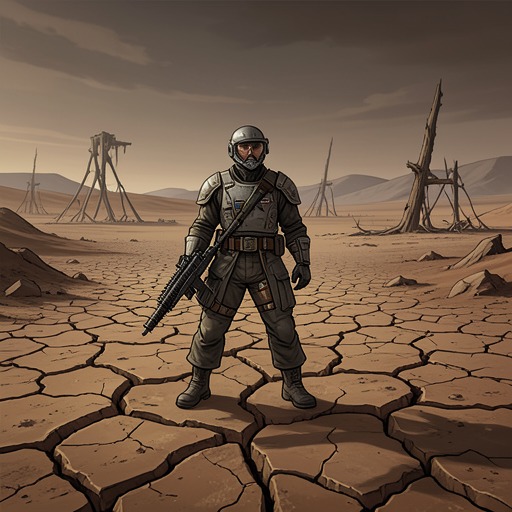
Barsoomian canals
A Princess of MarsThe Barsoomian canals belong to a planetary infrastructure shaped by environmental decline: as ancient seas receded, inhabitants followed the retreating water and ultimately built canals, while later agricultural systems conveyed water from polar reservoirs through conduits to cultivated districts. They stand both as a material answer to scarcity and as evidence that life on Mars depends on managed resources and technical cooperation.
Origins in the Receding Seas
Dejah Thoris describes Korad, an ancient city once known as a center of commerce and culture, as having been built beside a beautiful natural harbor enclosed by hills. In her account, the valley west of the ruined city is all that remains of that harbor; a pass through the hills had formed the channel by which ships once reached the city gates. The canals thus belong to a landscape transformed over immense spans of time, where former seaports and channels preserve the outline of waters that have vanished.
The shores of the ancient seas had been lined with cities, with smaller settlements extending toward the oceans’ centers. As the waters receded, people had to follow them; necessity eventually drove them to the system called the Martian canals. The canals are presented not as an isolated engineering marvel but as a civilizational response to a changing planet, following successive migrations away from the old coastlines.
Water, Agriculture, and Settlement
In the contemporary agricultural system, water for farms is collected in enormous underground reservoirs at both poles, where it comes from melting ice caps. It is pumped through long conduits to populated centers, and cultivated districts extend along those routes. This arrangement makes the water network a framework for settlement and farming, linking distant reserves to the places where people live and crops grow.
Water is not poured across the fields. A network of smaller pipes carries it underground directly to plant roots, limiting the loss that surface flooding would cause through evaporation. The crops are described as uniform because Mars has no droughts, rains, high winds, insects, or destructive birds. The canal-and-conduit system therefore operates within a tightly managed agricultural environment: controlled delivery of scarce water supports cultivation under conditions unlike Earth’s.
Environmental and Political Significance
The canals’ importance extends beyond irrigation. Dejah Thoris explains that her scientific expedition had been sent to rechart air currents and measure atmospheric density, and she argues that the work of her people helps maintain the air and water supply on Mars. Her appeal to the green warriors links technical labor and resource maintenance to a possible peace between communities, framing environmental survival as a shared interest despite longstanding hostility.
That appeal takes place against the background of a dying planet, where dwindling resources are also associated with harsh social arrangements and continual violence. The canals offer an image of collective adaptation, but they do not by themselves resolve conflict or scarcity. Their place in the story is more complicated: they embody both the ingenuity required to sustain life and the dependence of Martian societies on systems that must be maintained across a vulnerable, changing world.